

The power requirements of modern digital and industrial equipment are changing rapidly. AI computing, cloud infrastructure, high-density servers, industrial automation and connected equipment are placing greater demands on power systems, not only in terms of output capacity, but also efficiency, redundancy, thermal performance and long-term reliability.
For equipment manufacturers, system integrators and infrastructure operators, the power supply is therefore becoming a more important part of overall system design.
Powernexu provides server and industrial power solutions for applications ranging from data centres and AI computing platforms to industrial control, telecommunications and embedded equipment. Its portfolio includes CRPS server power supplies, redundant and hot-swappable power solutions, industrial AC-DC supplies, open-frame power products and power-distribution components.
Rather than selecting a power supply by wattage alone, modern systems increasingly require closer attention to the complete operating environment.
Higher Power Density Is Changing Server Design
Server platforms have become significantly more power-intensive as processors, GPUs, storage and networking equipment continue to increase in performance.
In a conventional enterprise server, the power system may have been treated as a relatively standard component. In a high-density AI or compute platform, however, power delivery has become a major engineering consideration.
The power supply must provide sufficient capacity while fitting within a restricted mechanical envelope. At the same time, it may need to support high conversion efficiency, controlled airflow, hot-swap operation and redundant architectures.
CRPS server power supplies are particularly relevant in this environment because their compact form factor allows system designers to achieve higher power density while retaining serviceability. High-power CRPS designs can support applications such as AI acceleration servers, GPU compute nodes and dense data-centre infrastructure.
For systems where uptime is important, redundant arrangements such as N+1 can allow a failed power module to be replaced without shutting down the entire platform. Hot-swappable modules can also simplify maintenance in data centres, storage platforms and other continuously operating environments.
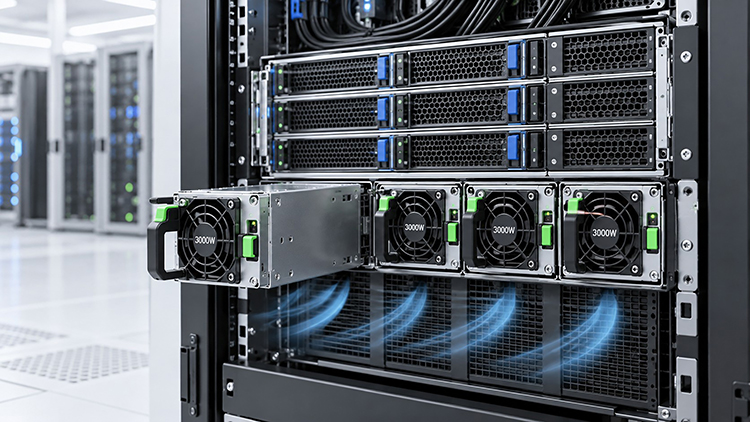
Power capacity alone, however, does not determine whether a supply is suitable.
Mechanical dimensions, connector layout, output voltage, airflow direction and compatibility with the target system all need to be checked. Even two power supplies with similar wattage ratings may not be interchangeable if their physical or electrical interfaces differ.
This makes accurate model matching increasingly important when replacing existing server power supplies or sourcing components for a new platform.
Industrial Power Requires a Different Set of Priorities
Industrial equipment creates a different challenge.
A power supply installed inside an industrial control system, communications device or embedded product may operate for long periods under conditions very different from those experienced by typical office electronics.
Temperature, enclosure airflow, input voltage variation, startup loads and installation space can all influence the final choice.
Open-frame AC-DC power supplies are often useful where equipment manufacturers need to integrate the power module directly into their own enclosure. Removing the external case can reduce size and give designers more flexibility over the internal mechanical layout.
However, this also means that mounting, insulation, airflow and protection must be considered as part of the finished system.
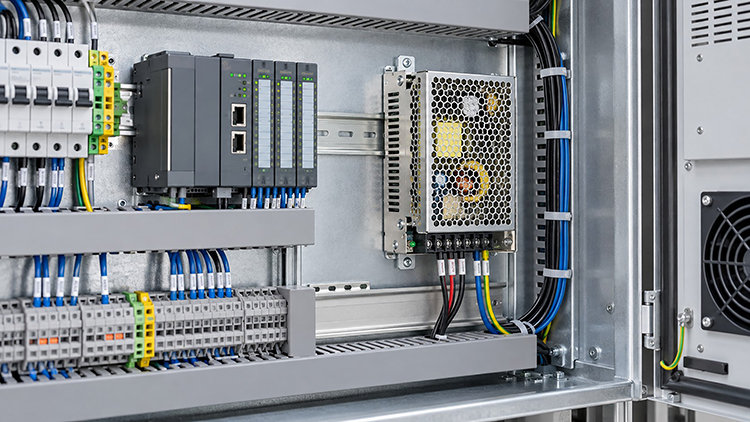
For industrial buyers, the correct question is therefore rarely simply, “How many watts do I need?”
A more useful assessment considers the available input source, required DC output, continuous and peak load, operating temperature, cooling method, installation format and expected duty cycle.
These factors can help prevent problems that only become visible after installation, such as overheating, unexpected shutdowns or insufficient power during transient loads.
A structured industrial power supply selection process should therefore evaluate the electrical, thermal, mechanical and environmental requirements of the complete installation rather than relying on output wattage alone.
Matching the Power Supply to the Application
A practical power-supply selection process begins with the application itself.
For server and computing projects, buyers should identify factors such as:
- required output power and voltage;
- CRPS, 1U, 2U or other mechanical format;
- redundancy and hot-swap requirements;
- connector and pinout compatibility;
- airflow direction;
- efficiency requirements; and
- system monitoring or communication requirements.
Industrial and OEM projects may additionally need to consider enclosure design, board mounting, insulation clearances, environmental conditions and how the power module will be cooled inside the final equipment.
This is why Powernexu focuses on matching power products to the actual operating requirements of the customer’s system rather than relying only on a model number or headline wattage.
Where an existing power supply needs to be replaced, information such as the original model, label, connector layout and required output can significantly reduce compatibility risk.
For new projects, understanding the application and system architecture early in the sourcing process can also help avoid unnecessary redesign later.
Supporting the Next Generation of Infrastructure
The distinction between traditional IT equipment and industrial infrastructure is also becoming less clear.
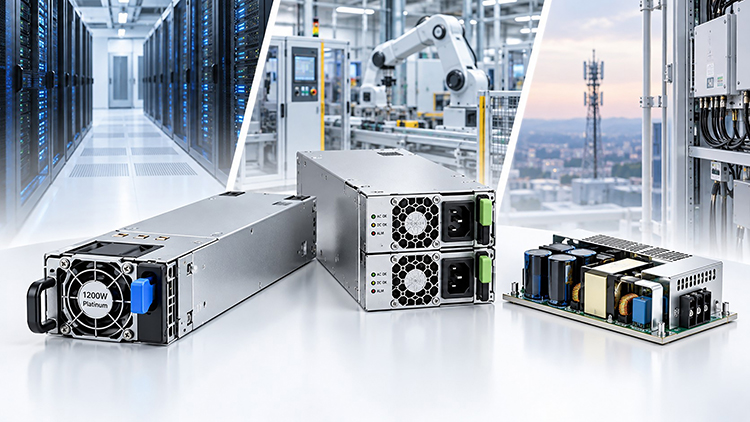
Edge computing, telecommunications, automation, AI and intelligent equipment increasingly combine high computing performance with industrial operating requirements.
As these systems become more powerful and more widely distributed, reliable power conversion and distribution will remain a fundamental part of their design.
The most suitable solution may be a high-density redundant CRPS module in a server rack, an open-frame AC-DC supply integrated into an OEM product, or another power architecture designed around the specific electrical and mechanical requirements of the equipment.
For Powernexu, the objective is to help customers identify a practical match between the power supply and the system in which it will operate.
More information about Powernexu’s server and industrial power solutions is available at Powernexu.com